What Are Polyolefins? Applications and Guidelines for Using Taical in Polyolefin-Based Products
Polyolefins are among the most important polymer materials in today’s plastics industry, accounting for more than 50% of global plastic consumption. With their excellent mechanical properties, ease of processing, cost efficiency, and relatively environmentally friendly characteristics compared to many other plastics, polyolefins are widely used in packaging, pipes, household products, industrial components, and more.
In this article, US MASTERBATCH provides a comprehensive overview of polyolefins, the benefits of incorporating Taical (Calcium Carbonate filler masterbatch), and technical guidelines for optimizing production.
1. What Are Polyolefins?

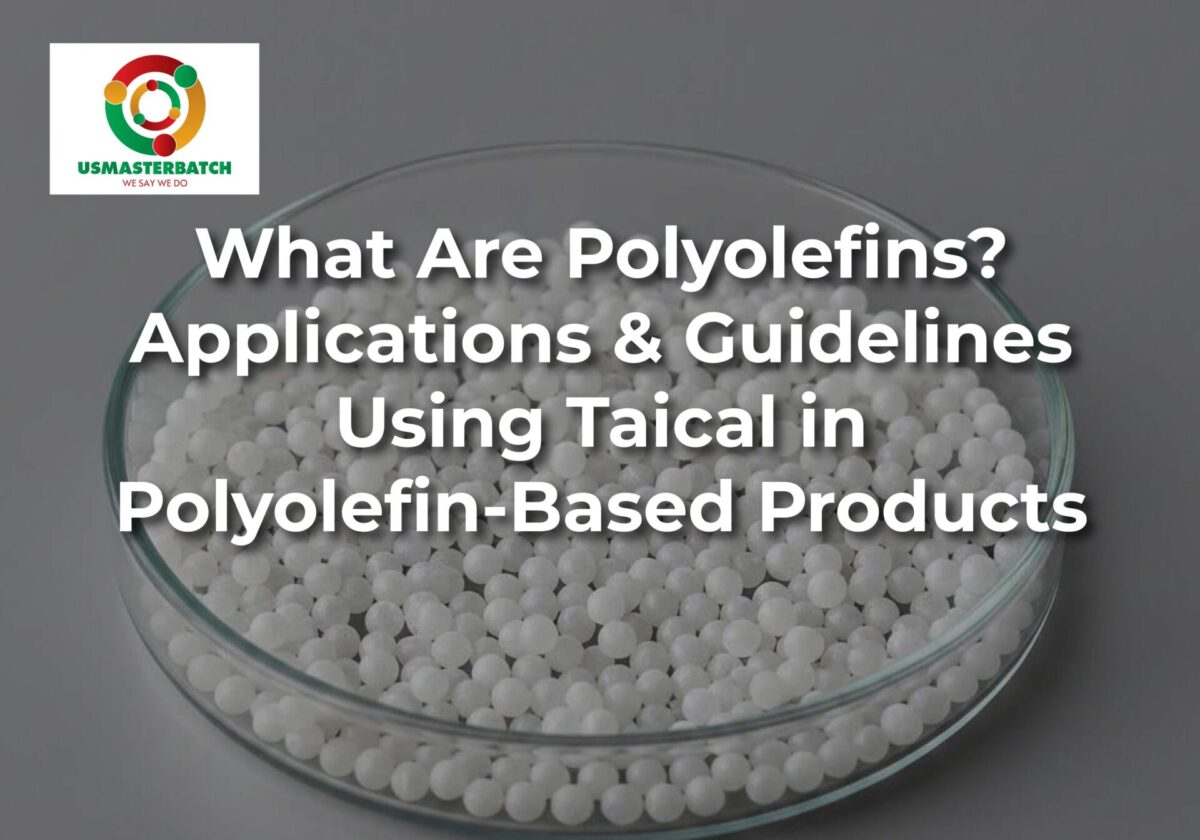
Polyolefins are polymers produced through the polymerization of olefins (alkenes), with the most common types being:
- Polyethylene (PE): LDPE, LLDPE, HDPE
- Polypropylene (PP): PP homopolymer, PP copolymer
Key Characteristics of Polyolefins
- Low density → reduced material cost
- Excellent chemical resistance
- Suitable for extrusion, injection molding, film blowing, and fiber production
- Safe for food applications when compliant with standards
- Easier to recycle compared to many other polymers
Thanks to these advantages, polyolefins are ideal carriers for combining with Taical – CaCO₃ filler masterbatch to reduce production cost while enhancing product performance.
2. What Is Taical and Why Is It Used in Polyolefins?
Taical is a commercial name commonly used in Vietnam to refer to CaCO₃ Filler Masterbatch – a plastic additive in pellet form that contains CaCO₃ powder, a polymer carrier resin (typically PP or PE), along with several additives that improve the properties of the final plastic product.
Main components of Taical:
- 70–85% ultra-fine CaCO₃
(sourced from natural limestone, whiteness 94–98%, particle size 1–2 microns or 8–12 microns depending on the application)
- 15–30% carrier resin
(determines which plastic Taical is compatible with; common carriers include PE, PP, and PS for applications such as bags, pipes, injection molding, and film blowing)
- A small amount of surface-treatment additives and dispersion aids
Benefits of Using Taical in Polyolefins
- Significant cost reduction
Taical is a low-cost raw material that helps manufacturers cut material costs by 10–30%.
- Improved stiffness and dimensional stability
CaCO₃ enhances rigidity and reduces shrinkage.
- Higher processing efficiency
- More stable extrusion performance
- Reduced shrinkage
- Better anti-deformation properties
- More stable extrusion performance
- Improved surface finish
Produces smoother, more uniform product surfaces.
- Better thermal conductivity during processing
→ Shorter cycle times and lower energy consumption.
3. Applications of Taical in Polyolefin Products
3.1. Packaging (PE & PP)
- Shopping bags
- HDPE garbage bags
- Woven PP sacks
- Agricultural films
Recommended loading: 10–35%
3.2. Injection-Molded Products
- Containers and trays
- Household items
- Plastic components
Recommended loading: 5–25%
3.3. Pipes and Pipe Fittings
- PP-R pipes
- HDPE pipes
- Irrigation systems
Recommended loading: 2–15% (depending on strength requirements)
3.4. Raffia and Woven Products
- PP woven bags
- PE fibers
Recommended loading: 5–12%
3.5. Sheets, Foam, and Industrial Items
- PP–PE sheets
- Recycled pallets
- Foam products
Recommended loading: 10–40%
4. Technical Guidelines for Using Taical in Polyolefins (US MASTERBATCH Standard)
4.1. Select the Right Taical Grade
- Carrier compatibility:
- PP → use PP-based Taical
- PE → use PE-based Taical
- PP → use PP-based Taical
- CaCO₃ fineness:
- 1 micron → films and thin packaging
- 2–3 microns → injection molding, pipes
- 1 micron → films and thin packaging
- Moisture <0.15% to avoid bubbles and voids
4.2. Recommended Dosage
| Applications | Taical Loading |
| HDPE/LDPE film blowing | 10 – 20% |
| PP woven sacks | 5 – 12% |
| Injection molding | 5 – 25% |
| Pipes | 2 – 10% |
| PP–PE sheets | 10 – 30% |
4.3. Processing Recommendations
- Maintain proper temperature profiles for each resin
- Avoid excessive screw speed to prevent CaCO₃ separation
- Dry the material at 60 – 80°C for 1 – 2 hours if humidity is high
- Ensure homogeneous mixing (vertical mixer or manual mixing)
4.4. Quality Control Checks
- Tensile strength and elongation
- Surface smoothness and whiteness
- Shrinkage and dimensional stability

5. Why Choose Taical from US MASTERBATCH?
- High-whiteness (98%) CaCO₃ sourced from premium Vietnamese mines
- European-standard compounding technology for superior dispersion
- Low moisture → no bubbles during processing
- Boosts output by 10 – 20%
- Competitive pricing for Middle East, Africa, South Asia, and ASEAN markets
Conclusion
Polyolefins (PP & PE) are excellent carriers for Taical, offering the perfect balance between performance and cost efficiency. When the right grade and dosage are used, Taical helps manufacturers significantly reduce raw material costs while improving stiffness, appearance, dimensional stability, and processing speed.
US MASTERBATCH is committed to providing technical support and tailored Taical solutions for every industry segment.