What is Non Woven Fabric?
Discover what non woven fabric is, its production processes (Spunbond, Meltblown), and how US Masterbatch’s high-quality PP Filler and Additives can optimize your production costs and performance.
Introduction
In the modern textile and plastic industries, non woven fabric has emerged as a revolutionary material. Unlike traditional textiles that rely on weaving or knitting yarns together, non woven fabrics offer a versatile, cost-effective, and highly functional alternative. From the protective masks we wear to the geotextiles used in massive infrastructure projects, non-woven materials are everywhere.
For manufacturers, understanding the science behind non woven fabrics and how to enhance their properties using advanced Masterbatch solutions is key to staying competitive in a global market. In this guide, US Masterbatch JSC — a leader in plastic compounding — explores everything you need to know about this essential material.
1. What is Non Woven Fabric?
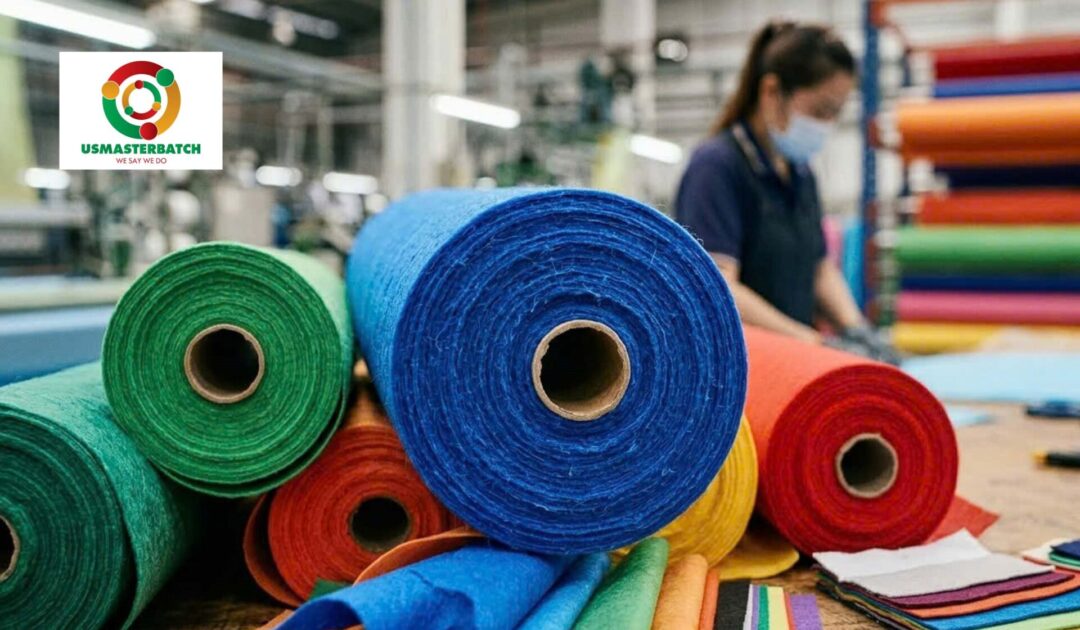
(Illustrative purposes only)
By definition, non woven fabric is a web or sheet of fibers bonded together mechanically, thermally, or chemically. The “non-woven” name comes from the fact that these fabrics do not require the conversion of fibers to yarn for weaving or knitting.
Typically made from petroleum-based polymers like Polypropylene (PP), Polyester, or Polyethylene, non-woven fabrics are engineered to have specific life-cycles: they can be single-use (disposable) or highly durable (long-lasting).
2. How is Non Woven Fabric Produced?
The production of non woven fabric is a fascinating high-speed process. The two most common methods in the industry today, especially for PP-based fabrics, are:
A. Spunbond Process
This is the most popular method for producing industrial non-wovens. Polymer pellets (primarily PP) are melted and extruded through a spinneret to create continuous filaments. These filaments are then cooled, deposited onto a moving belt, and bonded (usually thermally by heated rollers) to form a uniform web.
- Characteristics: High tensile strength, durability, and breathability.
- Common Use: Shopping bags, medical gowns, and furniture backing.
B. Meltblown Process
While similar to spunbonding, the meltblown process uses high-velocity hot air to attenuate the extruded filaments into extremely fine micro-fibers (often less than 1-5 microns in diameter).
- Characteristics: Exceptional filtration efficiency and liquid barrier properties.
- Common Use: High-filtration face masks (N95), oil absorbents, and insulation.
At US Masterbatch, we understand that the quality of the final fabric starts with the quality of the raw material. Our specialized PP Filler Masterbatch is designed to integrate seamlessly into these high-speed extrusion lines.
3. Key Advantages of Non Woven Fabric
Why has the world shifted toward non-woven materials? The benefits are clear:
- Cost-Efficiency: The production cycle is much shorter than traditional weaving, significantly reducing labor and energy costs.
- Customizability: You can “engineer” the fabric to be absorbent, liquid-repellent, flame retardant, UV resistant, or anti-static.
- Lightweight yet Strong: Despite being thin, non-woven webs offer excellent tear resistance.
- Eco-friendliness: When made from PP, non-wovens can be recycled, and with the addition of Bio-based compounds, they can become even more sustainable.
4. Major Applications of Non Woven Fabric
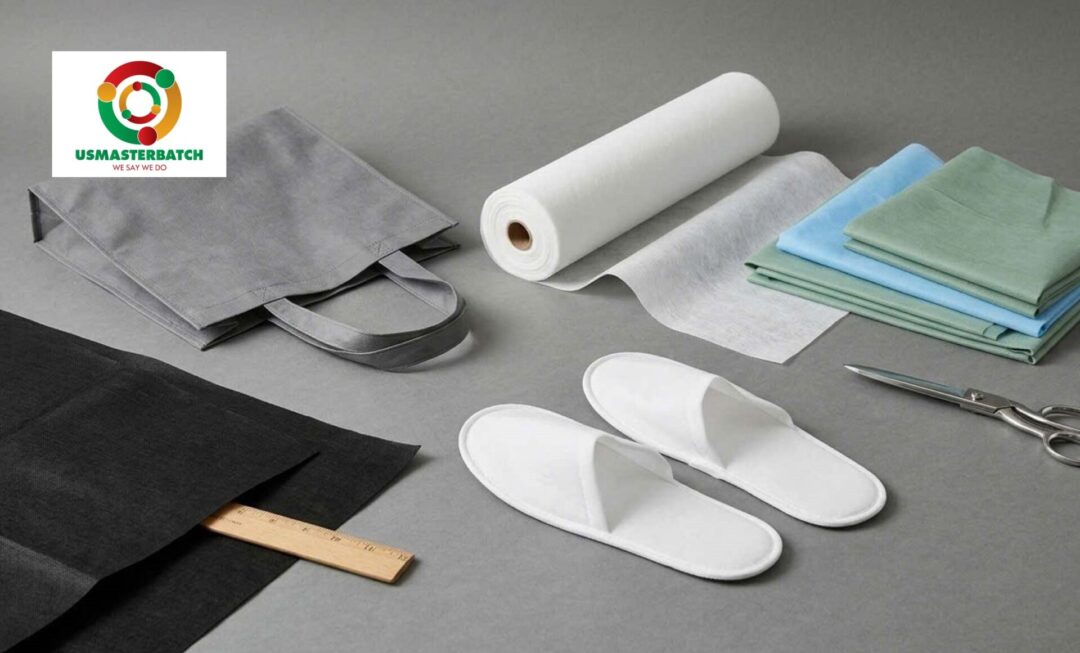
(Illustrative purposes only)
- Medical & Healthcare: Surgical masks, caps, drapes, and disposable hospital bedding.
- Agriculture: UV-stabilized crop covers that protect plants from pests and frost while allowing water and light through.
- Packaging: Eco-friendly “bags for life”, flour sacks, and industrial wraps.
- Hygiene: Diapers, sanitary napkins, and wet wipes.
- Automotive: Interior carpets, headliners, and sound insulation panels.
5. The Role of Masterbatch in Non-Woven Excellence
As a manufacturer, your goal is to balance product quality with cost optimization. This is where the expertise of a world-class compounder like US Masterbatch becomes invaluable.
Optimizing Costs with Filler Masterbatch
Using 100% virgin PP resin for non-woven production can be expensive. Our PP Filler Masterbatch (Calcium Carbonate based) is specifically formulated for non-woven applications.
- High Dispersion: Our R&D team ensures that the CaCO3 particles are ultra-fine (1-2 microns) to prevent filter clogging and spinning breaks.
- Cost Reduction: Manufacturers can replace a significant percentage of virgin resin with our filler without losing the physical strength of the fabric.
- Enhanced Whiteness: It provides a natural white base, reducing the need for expensive TiO2 pigments.
Functional Additives for Value-Added Fabrics
To turn a basic non-woven sheet into a high-performance product, specialized additives are required:
- UV Stabilizer Masterbatch: Crucial for agricultural and outdoor covers to prevent degradation from sunlight.
- Anti-Static Masterbatch: Essential for electronics packaging and medical environments.
- Color Masterbatch: Providing vibrant, consistent colors for the fashion and packaging sectors.
6. Why Choose US Masterbatch JSC for Your Non-Woven Needs?
With over a decade of experience and a production capacity of 408,000 tons per year, US Masterbatch is not just a supplier — we are your strategic partner.
- Global Standard Quality: Our 04 factories operate under ISO 9001:2015 standards, ensuring every batch meets the strict requirements of international markets.
- Advanced R&D: We have developed over 150 superior quality solutions. Our experts work closely with your technical team to customize the Melt Flow Index (MFI) and dispersion properties of our compounds to match your specific machinery.
- Presence in 80+ Countries: We understand the global trends and regulatory requirements for non-woven materials across Europe, the Middle East, and the Americas.
Conclusion
Non woven fabric is a cornerstone of modern manufacturing, offering endless possibilities for innovation. Whether you are producing medical-grade Meltblown filters or heavy-duty Spunbond shopping bags, the secret to success lies in the chemistry of your materials.
US Masterbatch JSC is committed to helping you “Do what we say”. We provide the technical expertise and high-quality Masterbatch solutions needed to enhance your fabric’s performance while significantly lowering production costs.
Ready to optimize your non-woven production? Contact US Masterbatch today for a technical consultation and sample testing. Let’s build a more efficient and sustainable future together.