
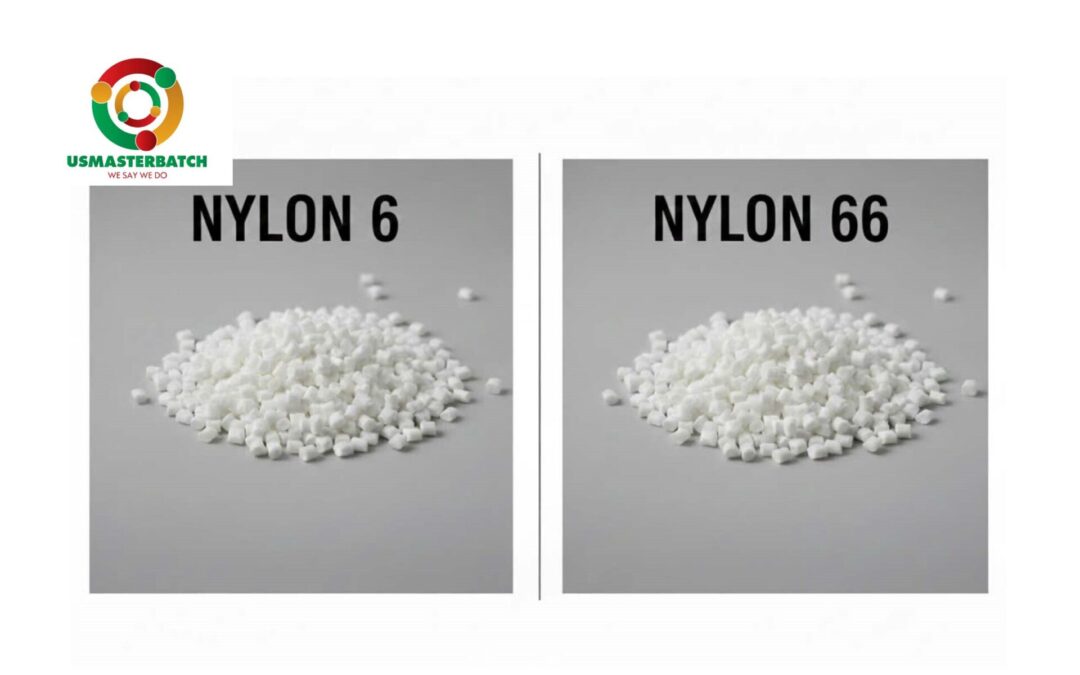
Nylon 6 vs. Nylon 66: A Technical Comparison for Plastic Manufacturers
[US Masterbatch] In the world of engineering plastics, Polyamides (commonly known as Nylon) reign supreme due to their exceptional durability, high strength, and resistance to heat and chemicals. However, for manufacturers and R&D engineers, a common dilemma arises during the material selection process: Should we use Nylon 6 (PA6) or Nylon 66 (PA66)?
While they share a similar name and belong to the same polymer family, PA6 and PA66 exhibit distinct characteristics that can make or break your final product. This article breaks down the technical differences between Nylon 6 and Nylon 66 to help you make an informed decision.
1. Chemical Structure: The Root of the Difference Nylon 6 and Nylon 66
To understand how they perform, we must look at how they are made. The numbers “6” and “66” refer to the number of carbon atoms between the amine and acid groups in the polymer chain.
- Nylon 6 (PA6): It is synthesized by a single monomer called Caprolactam. Through a process called ring-opening polymerization, it forms a structure with 6 carbon atoms. Its crystalline structure is generally more open.
- Nylon 66 (PA66): It is created by polymerizing two monomers: Hexamethylenediamine and Adipic Acid (both containing 6 carbon atoms, hence “66”). This creates a tighter, more dense molecular structure with stronger hydrogen bonds.
Why does this matter? The tighter structure of PA66 generally leads to higher stiffness and thermal resistance, while the more open structure of PA6 allows for better flexibility.
2. Key Performance Differences Nylon 6 and Nylon 66
When selecting resin for injection molding or extrusion, consider these four critical factors:
A. Thermal Resistance and Melting Point
If your product operates in a high-temperature environment (e.g., under a car hood), PA66 is the superior choice.
- Nylon 66: Has a higher melting point of approximately 260°C (500°F). It maintains its stiffness and mechanical integrity better at high temperatures.
- Nylon 6: Has a lower melting point of approximately 220°C (428°F). While it is still heat resistant compared to commodity plastics (like PE or PP), it softens earlier than PA66.
B. Water Absorption
Nylons are “hygroscopic” meaning they absorb moisture from the air. This affects dimensional stability (the part might swell) and mechanical properties.
- Nylon 6: Absorbs more moisture than PA66. While this can make the part tougher and more impact-resistant after conditioning, it also means the part is less dimensionally stable in humid environments.
- Nylon 66: Absorbs less moisture. It retains its shape and stiffness better when exposed to water or high humidity.
C. Processability and Surface Finish
For manufacturers focused on aesthetics and ease of molding:
- Nylon 6: Generally easier to process due to its lower melting point. It offers a broad processing window and typically results in a superior surface finish (smoother and glossier). It also has lower mold shrinkage, making it great for complex shapes.
- Nylon 66: Requires higher processing temperatures. Due to its fast crystallization rate, mold shrinkage is higher, which can be challenging for parts requiring extremely tight tolerances.
D. Mechanical Strength
- Stiffness: PA66 is stiffer and has a higher tensile modulus.
- Toughness: PA6 is generally tougher and has better impact resistance and long-term fatigue resistance, especially after it has absorbed some equilibrium moisture.
3. Applications: Which One Fits Your Industry?

Based on the properties above, here is how the industry typically divides the usage:
| Feature | Nylon 6 (PA6) | Nylon 66 (PA66) |
| Ideal Industries | Automotive (Exterior), Electronics, Packaging. | Automotive (Under-hood), Industrial, Electrical. |
| Typical Products | Gears, casings, stadium seats, fasteners, films. | Radiator tanks, cable ties, intake manifolds, and circuit breakers. |
| Key Advantage | Better surface appearance & impact strength. | Superior heat resistance & stiffness. |
Conclusion
The choice between Nylon 6 and Nylon 66 depends entirely on your end product’s requirements. Choose PA6 if you need excellent surface finish, impact resistance, and ease of processing. Choose PA66 if your product demands high rigidity and exposure to high temperatures.