
Popular Halogen Free Flame Retardant Types (HFFR)
In the modern plastics industry, safety standards such as RoHS and REACH have pushed manufacturers to move away from traditional halogenated additives. Halogen Free Flame Retardant (HFFR) has emerged as the gold standard for creating fire-resistant plastic products without the toxic byproduct of halogenated smoke.
As a leading manufacturer — US Masterbatch — we understand that choosing the right flame retardant is critical for maintaining mechanical properties while ensuring peak safety.
1. What is Halogen Free Flame Retardant (HFFR)?
Halogen free flame retardant is additive integrated into polymer matrices (PE, PP, PA, ABS) to inhibit, suppress, or delay the combustion process. Unlike brominated or chlorinated flame retardants, HFFR compounds do not release corrosive gases (like HCl or HBr) during a fire, making them ideal for high-population density areas and electronics.
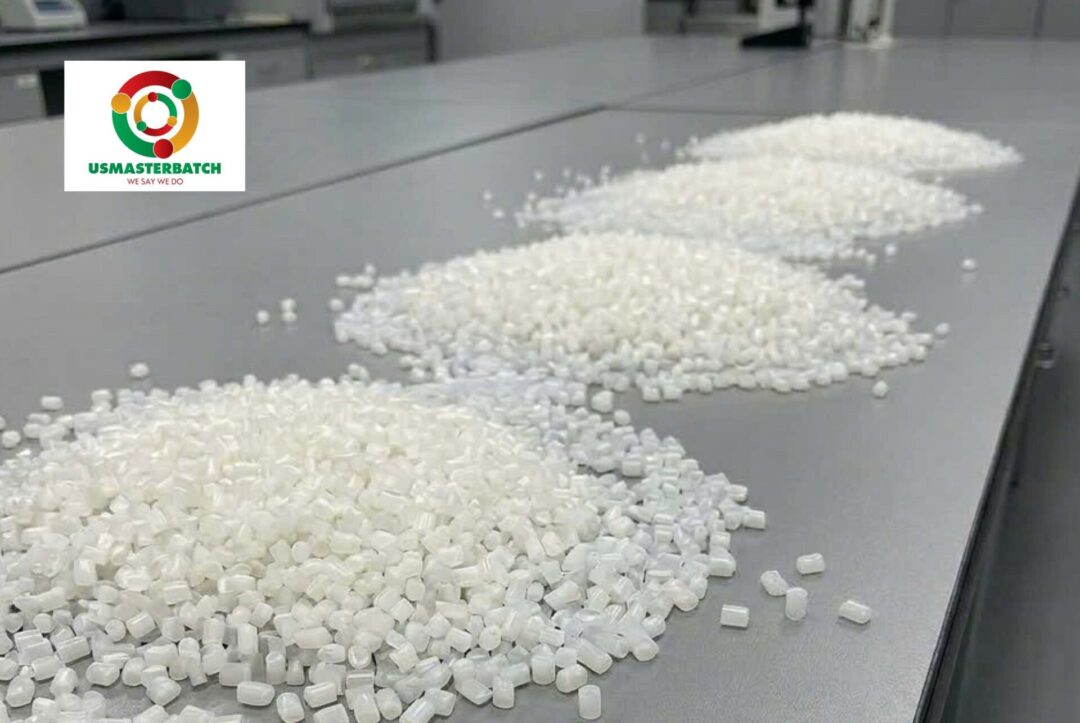
(Illustrative purposes only)
2. Most Popular Halogen Free Flame Retardant Types
Depending on the polymer base and the final application (injection molding, film blowing, or extrusion), different chemical groups are utilized.
A. Aluminum Diethyl Phosphinate (ADP) & Phosphorus-based HFFR
Phosphorus-based retardants are highly effective in oxygen-containing polymers like Polyamide (PA) and Polyesters.
- Mechanism: They act primarily in the condensed phase by promoting char formation. This carbonaceous layer acts as a thermal barrier, protecting the underlying plastic from oxygen and heat.
- Applications: Widely used in electronic connectors and automotive parts.
B. Magnesium Hydroxide Mg(OH)3 & Aluminum Trihydrate Al(OH)3
These are the most common inorganic HFFRs used in the wire and cable industry.
- Mechanism: They work through endothermic decomposition. When exposed to fire, they release water vapor, which cools the polymer and dilutes the combustible gases.
- Pros: Low cost, non-toxic, and excellent smoke suppression.
- Cons: Requires high loading levels (often 50%), which can impact the mechanical strength of the resin.
C. Intumescent Flame Retardants (IFR)
IFR systems usually consist of three components: a phosphorus source (acid source), a carbon source (charring agent), and a gas source (foaming agent).
- Mechanism: Upon heating, these components react to form a thick, insulating foamed char.
- Applications: Excellent for PP (Polypropylene) and PE (Polyethylene) applications like construction panels and stadium seating.
D. Nitrogen-based Flame Retardants (Melamine Derivatives)
Commonly used in Polyurethane (PU) foams and Polyamides.
- Mechanism: They release inert nitrogen gas which dilutes the oxygen around the flame and interferes with the combustion chemistry.
3. Comparison of Common Halogen Free Flame Retardant Additives
| Criteria | Metal Hydroxides (ATH/MDH) | Phosphorus-based (ADP) | Intumescent Systems (IFR) |
| Loading Amount | High (50-70%) | Low to Medium (15-25%) | Medium (20-30%) |
| Smoke Density | Very Low | Moderate | Low |
| Main Advantage | Eco-friendly & Cheap | High Efficiency | Superior Char Formation |
| Best For | Wire & Cable (PE/PVC) | Engineering Plastics (PA) | Polyolefins (PP/PE) |
4. Technical Challenges: Dispersion and Particle Size
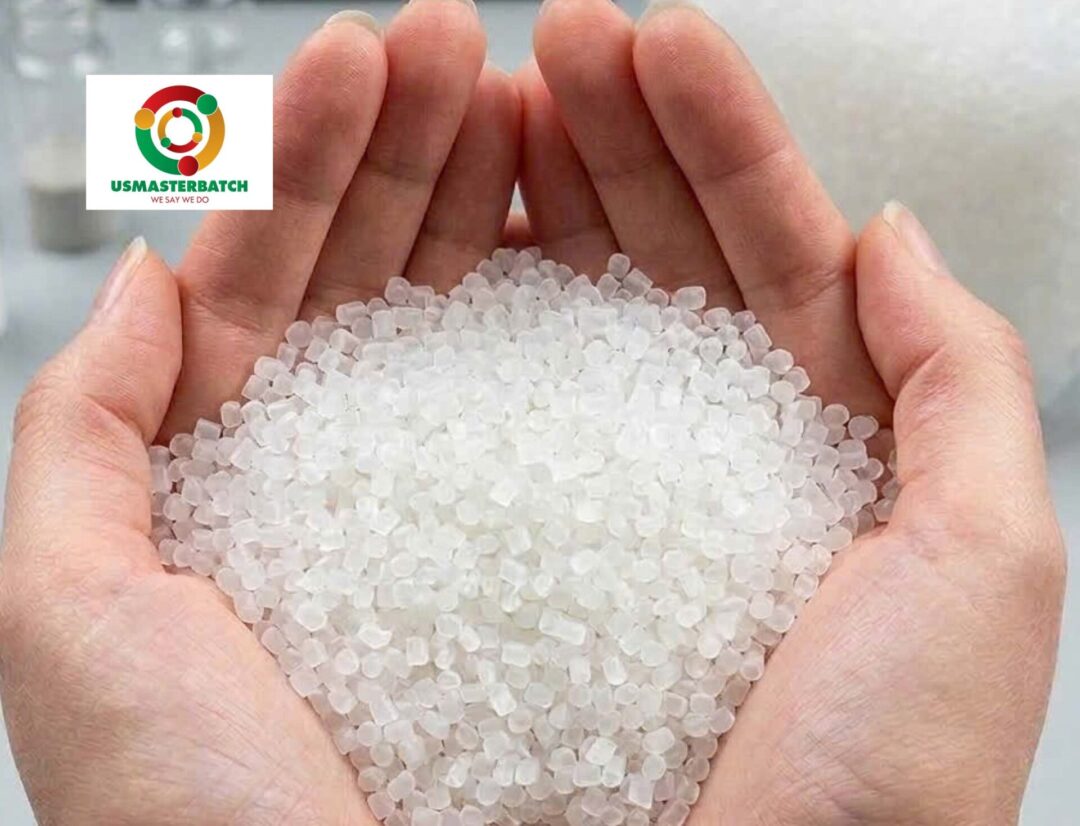
(Illustrative purposes only)
For a flame retardant to work effectively without ruining the plastic’s physical integrity, dispersion is key.
- The Problem: High loading of Mg(OH)2 can make the plastic brittle or cause surface defects.
- The Solution: Using high-quality Flame Retardant Masterbatches. At US Masterbatch, we utilize advanced twin-screw extrusion technology to ensure that flame retardant particles are coated and dispersed uniformly within the carrier resin (PE or PP).
5. Why Choose Halogen Free Flame Retardant Solutions from US Masterbatch?
Since our establishment in 2016, US Masterbatch Joint Stock Company has climbed to the Top 2 position in the industry by focusing on “Quality through Science”. Our Halogen Free Flame Retardant masterbatch solutions provide:
- Compliance: Fully compliant with UL94 V-0, V-1, and V-2 flammability standards.
- Safety: Free from Pb, Cd, Hg, and Cr6+, meeting FDA and RoHS requirements for global export.
- Processability: Our formulations include specialized processing aids to ensure smooth extrusion and injection molding, even at high additive concentrations.
- Customization: We tailor the carrier resin and flame retardant concentration to match your specific end-product requirements.
6. Conclusion
Switching to Halogen Free Flame Retardant is no longer just a trend — it is a regulatory necessity for high-end markets like the EU and USA. Whether you are producing flame-retardant corrugated pipes, electronic housings, or industrial films, selecting the right HFFR chemistry is the first step toward a safer, more sustainable product.
Looking for a technical consultation on Halogen Free Flame Retardant Masterbatch?
Contact US Masterbatch today. Our experts with 10+ years of experience are ready to help you optimize your formula for both safety and cost-efficiency.