PBT Masterbatch – Optimizing Engineering Plastic Performance
1. Defining PBT Masterbatch: The Core Chemistry
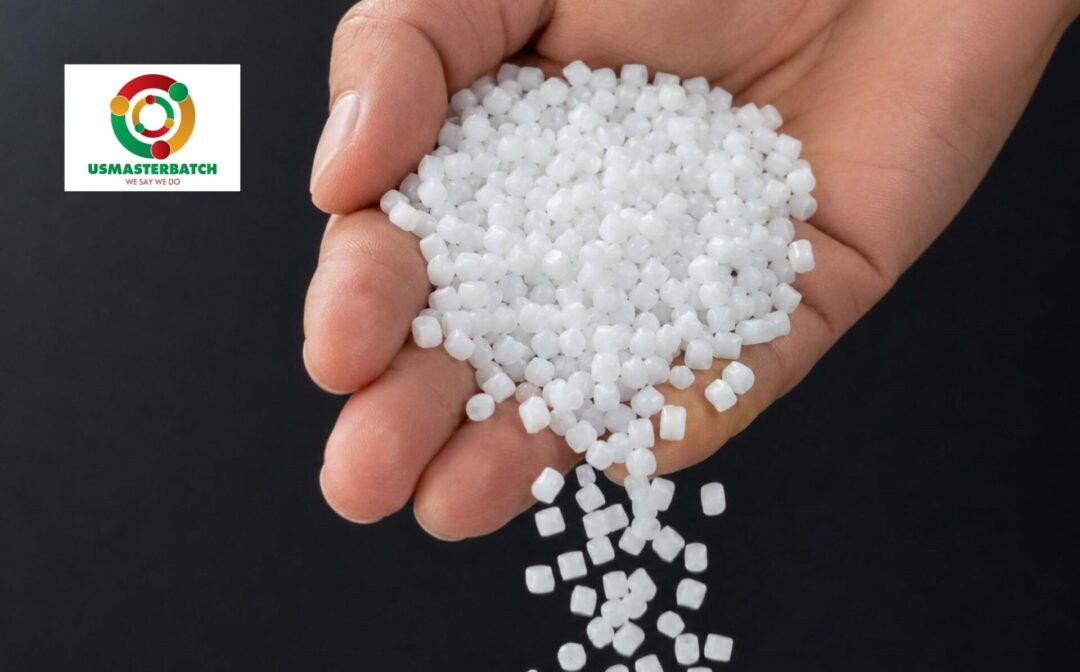
(Illustrative purpose only)
PBT (Polybutylene Terephthalate) Masterbatch is a highly concentrated pelletized mixture consisting of pigments, functional additives, and a specialized carrier resin. Unlike standard masterbatches that utilize Polyethylene (PE) or Polypropylene (PP) as a base, PBT Masterbatch uses virgin PBT – a semi-crystalline thermoplastic polyester – as its carrier.
At the molecular level, PBT is produced through the polycondensation of terephthalic acid or dimethyl terephthalate with 1,4-butanediol. By using the same resin as the base polymer of the final product, we ensure that the “thermodynamic compatibility” is maximized. This prevents the microscopic phase separation that often occurs when mismatched resins are blended, which can lead to catastrophic mechanical failure in high-stress applications.
2. Why PBT Masterbatch? The Technical Advantages
At US Masterbatch, our R&D team emphasizes five pillars of performance that make PBT Masterbatch indispensable for technical molding:
- Superior Thermal Endurance
PBT has a high melting point (approximately 223°C) and a high glass transition temperature. Our PBT Masterbatch is formulated to withstand processing temperatures that would cause standard pigments to degrade or “burn”. This thermal stability ensures that the color remains vibrant and the polymer chain remains intact during high-heat injection molding or extrusion cycles.
- Dimensional Stability and Low Moisture Absorption
One of the most critical challenges in engineering plastics is “hygroscopy” (the tendency to absorb moisture). Unlike Polyamide (Nylon), PBT has an extremely low moisture absorption rate. Our masterbatch maintains this characteristic, ensuring that the final parts do not swell or lose dimensional precision when exposed to humid environments – a non-negotiable requirement for connectors and sensor housings.
- Dielectric Strength and Electrical Insulation
The electronics industry relies on PBT for its excellent dielectric properties. Our PBT Masterbatch is engineered using “electrical-grade” pigments that do not interfere with the polymer’s natural ability to insulate. This prevents electrical tracking and ensures safety in high-voltage components.
- Chemical Resistance
PBT Masterbatch provides the final product with a robust shield against a wide array of chemicals, including aliphatic hydrocarbons, alcohols, ethers, and dilute acids. This makes it ideal for under-the-hood automotive applications where exposure to oils and fuels is common.
- Enhanced Surface Finish and Dispersion
Utilizing our proprietary Triple Screw Extrusion technology, we achieve a level of pigment dispersion that exceeds industry standards. Fine dispersion reduces the “notching effect” (where poorly dispersed pigment clumps act as stress concentrators), thereby significantly improving the impact strength of the final molded part.
3. The US Masterbatch Production Excellence
The quality of a PBT Masterbatch is determined long before it reaches the molding machine. At US Masterbatch, our “We Say We Do” philosophy is backed by a rigorous production protocol:
- Strategic Sourcing: We utilize premium-grade PBT resins with specific Intrinsic Viscosity (IV) levels to match the flow requirements of our clients’ processes. Pigments are selected based on their Light Fastness (Blue Wool Scale) and Heat Stability.
- Advanced Rheology Control: During the pre-mixing stage, we incorporate specialized processing aids that optimize the melt flow index (MFI). This ensures that even at high pigment loading (up to 40-50%), the masterbatch integrates seamlessly into the let-down resin.
- The Triple Screw Advantage: Our factories in Thach That and Hung Yen utilize Triple Screw Extruders. This technology provides superior distributive and dispersive mixing compared to traditional twin-screw systems. It allows for lower melt temperatures, which preserves the chemical integrity of the additives.
- Vacuum Degassing and Filtration: To ensure the highest purity, our melt filtration systems remove any microscopic impurities, while vacuum degassing eliminates volatiles that could cause porosity in the final product.
- Stringent Quality Assurance (QA): Each batch undergoes a battery of tests:
- Spectrophotometric Analysis: Using Datacolor technology to ensure ∆E (color deviation) is within the tightest tolerances.
- TGA (Thermogravimetric Analysis): To verify the exact inorganic content and thermal degradation profile.
- Moisture Content Testing: Ensuring the product is vacuum-packed at <0.1% moisture to prevent hydrolysis during processing.
4. Industrial Applications of PBT Masterbatch

(Illustrative purpose only)
The versatility of PBT Masterbatch allows it to serve the most demanding sectors:
- Automotive Engineering: Used for ignition system components, sensor housings, and interior decorative parts. It withstands the harsh vibration and thermal cycling of the engine bay.
- Electrical & Electronics: Ideal for fiber optic buffer tubes, micro-switches, and high-precision connectors (SFP/QSFP housings) where signal integrity is paramount.
- Industrial Components: High-wear parts such as gears, cams, and conveyor belt links benefit from the low friction and high abrasion resistance provided by the PBT matrix.
5. Sustainability and Future Trends
As a forward-looking partner, US Masterbatch is also integrating sustainable practices into our PBT line. We are exploring the use of PCR (Post-Consumer Recycled) PBT carriers and developing “Cool Color” masterbatches that reflect infrared radiation, reducing heat buildup in outdoor electronic enclosures.
Conclusion
Choosing the right PBT Masterbatch is not just about choosing a color; it is about choosing a technical partner who understands the intricacies of polymer science. At US Masterbatch, we combine 15 years of B2B expertise with world-class manufacturing to provide solutions that don’t just meet standards – they set them.