
Optimized Polymer Solutions with US Masterbatch
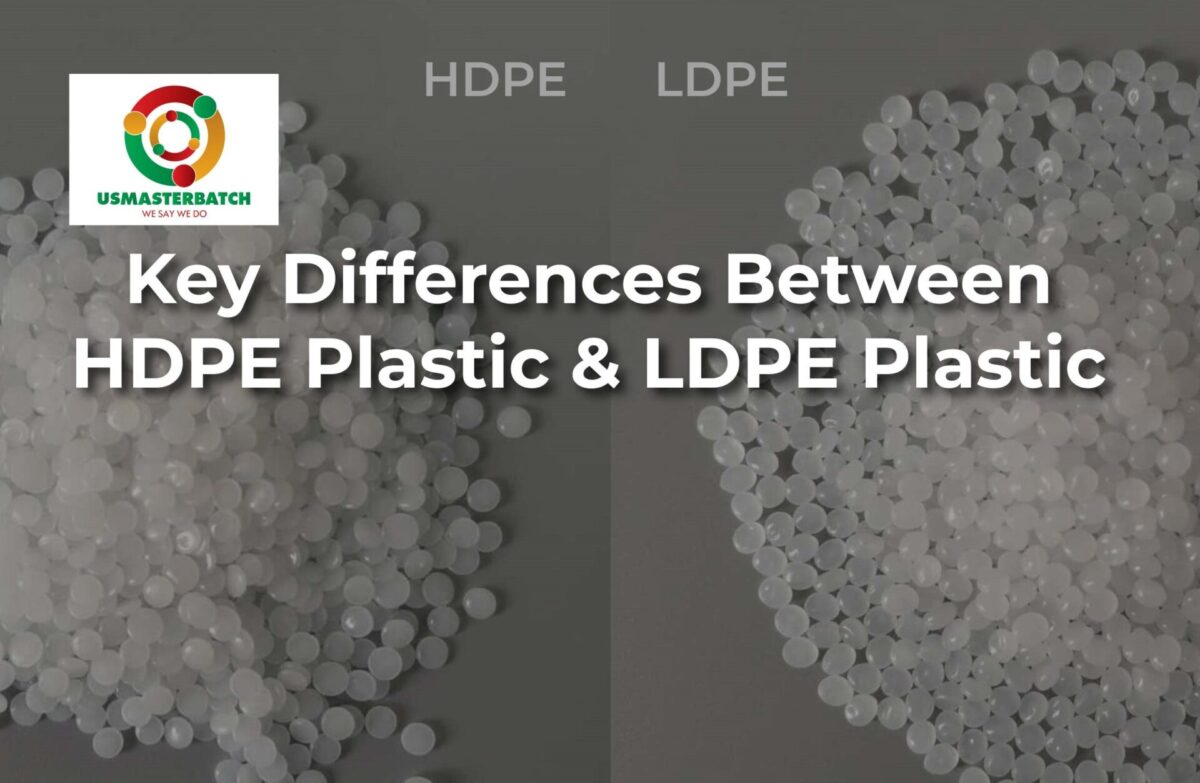
In the modern plastics industry, polyethylene (PE) remains one of the most widely used thermoplastic polymers worldwide. Thanks to its excellent balance between performance, processability, and cost efficiency, polyethylene is present in nearly every aspect of daily life — from packaging and consumer goods to industrial and agricultural applications. Among the various polyethylene types, HDPE (High Density Polyethylene) 和 LDPE (Low Density Polyethylene) are the two most commonly used grades. Although they share the same basic chemical structure, their molecular architecture, physical properties, processing behavior, and end-use applications differ significantly. 在这篇文章中, US Masterbatch provides an in-depth comparison between HDPE plastic and LDPE plastic, while also highlighting how advanced masterbatch solutions can enhance the performance and value of both materials.
1. Overview of Polyethylene (PE)
 Differences Between HDPE Pl
Polyethylene is a thermoplastic polymer produced from the polymerization of ethylene monomers. It is known for:
- Excellent chemical resistance
- Good mechanical strength
- Ease of processing
- Cost-effectiveness
- Wide application range
Based on density, molecular weight, and branching structure, polyethylene is classified into several categories, including HDPE, LDPE, LLDPE, and others. Among these, HDPE and LDPE dominate global consumption due to their versatility and reliability.
2. What Is HDPE Plastic?
2.1 Definition of HDPE
HDPE (High Density Polyethylene) is a polyethylene material characterized by a linear molecular structure with minimal branching. This structure allows polymer chains to pack closely together, resulting in higher density and stronger intermolecular forces.
2.2 Key Properties of HDPE
- Density range: 0.94 – 0.97 g/cm³
- High tensile strength and stiffness
- Excellent impact resistance
- Superior chemical and moisture resistance
- Higher melting point compared to LDPE
- Matte or semi-matte surface appearance
2.3 Advantages of HDPE
- Outstanding mechanical strength
- High load-bearing capacity
- Long service life
- Good dimensional stability
- Suitable for rigid and semi-rigid products
2.4 Limitations of HDPE
- Lower flexibility compared to LDPE
- Less transparent and glossy
- More difficult to process into very thin films
3. What Is LDPE Plastic?
3.1 Definition of LDPE
LDPE (Low Density Polyethylene) has a highly branched molecular structure, which prevents polymer chains from packing tightly. As a result, LDPE exhibits lower density, higher flexibility, and better optical properties.
3.2 Key Properties of LDPE
- Density range: 0.91 – 0.93 g/cm³
- Excellent flexibility and elongation
- High transparency and surface gloss
- Good impact resistance at low temperatures
- Easy melt flow and processing
- Lower melting point
3.3 Advantages of LDPE
- Exceptional softness and flexibility
- Ideal for thin and flexible films
- Attractive appearance for packaging
- Easy to process via film blowing
3.4 Limitations of LDPE
- Lower tensile strength
- Reduced stiffness and rigidity
- Limited load-bearing capacity
- Lower heat resistance compared to HDPE
4. Molecular Structure Differences Between HDPE plastic and LDPE plastic
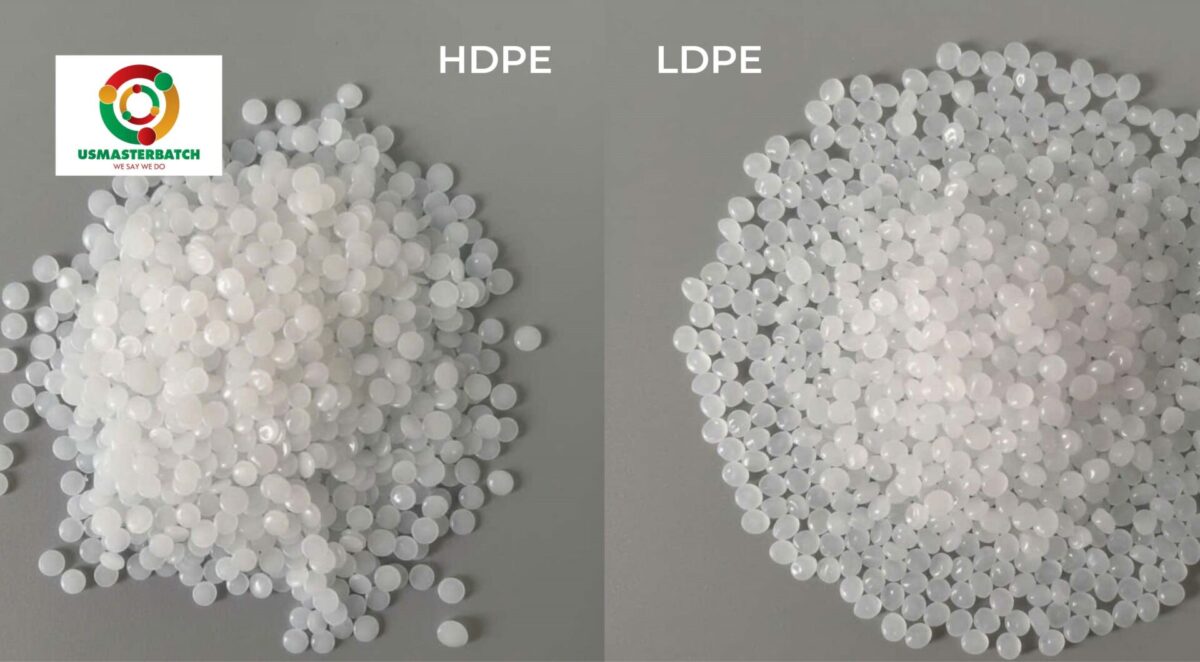
The fundamental difference between HDPE and LDPE lies in their molecular chain structure:
- HDPE has long, linear chains with very few side branches, enabling close molecular packing and high crystallinity.
- LDPE contains numerous short and long chain branches, leading to lower crystallinity and weaker intermolecular forces.
This structural variation directly influences:
- Density
- Mechanical strength
- Thermal behavior
- Optical properties
- Processability
5. Detailed Comparison: HDPE plastic and LDPE plastic
| Criteria | HDPE | LDPE |
|---|---|---|
| Density | High | Low |
| Molecular structure | Linear, low branching | Highly branched |
| Tensile strength | High | Lower |
| Flexibility | Limited | 优秀 |
| Transparency | Low | High |
| Surface gloss | Medium | High |
| Heat resistance | Better | Lower |
| Typical processing | Injection molding, extrusion | Film blowing, extrusion |
| Cost efficiency | High | Slightly higher |
6. Typical Applications of HDPE
Due to its rigidity and strength, HDPE is widely used in applications that require durability and structural integrity, such as:
- Chemical containers and detergent bottles
- Water pipes and drainage systems
- Industrial pallets and crates
- Caps and closures
- Rigid packaging
- Heavy-duty liner bags
Role of US Masterbatch in HDPE Applications
US Masterbatch solutions help HDPE manufacturers:
- Improve stiffness and impact resistance
- Enhance color consistency and opacity
- Reduce raw material costs through filler optimization
- Improve processing stability
- Maintain consistent quality across multiple shipments
7. Typical Applications of LDPE
LDPE is preferred for products that require softness, flexibility, and aesthetic appeal, including:
- Shopping bags and garbage bags
- Food packaging films
- Agricultural mulch films
- Shrink and stretch films
- Inner liners and flexible packaging
Role of US Masterbatch in LDPE Applications
US Masterbatch enhances LDPE performance by:
- Increasing whiteness and brightness
- Improving film smoothness and gloss
- Enhancing melt flow during film blowing
- Improving tear resistance
- Ensuring color stability between production lots
8. Why Masterbatch Is Essential for HDPE and LDPE
In modern plastic manufacturing, masterbatch plays a critical role by:
- Enhancing physical and mechanical properties
- Improving aesthetics and product consistency
- Reducing dependence on virgin resin
- Improving processing efficiency
- Extending product lifespan
9. US Masterbatch Solutions for HDPE and LDPE
9.1 Filler Masterbatch
- Reduces material cost
- Improves stiffness (especially effective in HDPE)
- Enhances dimensional stability
9.2 White Masterbatch
- High TiO₂ dispersion
- Neutral white shade without bluish or yellowish tone
- Suitable for both HDPE and LDPE
- Excellent consistency across containers
9.3 Additive Masterbatch
- UV stabilizers for outdoor applications
- Antioxidants for thermal stability
- Anti-block and slip additives for film applications
- Processing aids for smooth production
10. How to Choose Between HDPE and LDPE
Manufacturers should evaluate:
- End-product requirements
- Mechanical strength vs. flexibility
- Product thickness
- Appearance expectations
- Cost targets
- Masterbatch compatibility
👉 US Masterbatch technical team provides professional support to help customers select the optimal polymer and masterbatch combination.
11. Sustainability and Recycling Considerations
Both HDPE and LDPE are recyclable and widely accepted in recycling streams. However:
- HDPE is easier to recycle due to its rigidity
- LDPE recycling requires better sorting and processing
US Masterbatch develops eco-friendly masterbatch solutions that:
- Support recycled PE applications
- Improve performance of recycled HDPE and LDPE
- Maintain consistent quality while reducing environmental impact
12. Conclusion
Although HDPE and LDPE belong to the same polyethylene family, their structural differences lead to distinct mechanical, thermal, and processing characteristics. Selecting the correct material is essential to achieving optimal performance, cost efficiency, and product reliability.
With deep industry expertise and advanced formulation capabilities, US Masterbatch delivers comprehensive masterbatch solutions that help manufacturers:
- Optimize HDPE and LDPE performance
- Improve product quality
- Control production costs
- Strengthen global competitiveness
US Masterbatch – Your Reliable Partner in Advanced Polyethylene Solutions.